Blogs

How Predicting Risk Prevents Logistics Disruption

Published: 27 August 2025 · Updated: 16 September 2026

In this article we will discuss:

  • Why many logistics risks follow detectable patterns that give you time to prepare.
  • How predictive risk intelligence can help you anticipate both an event and its downstream effects.
  • Why acting before a disruption escalates gives you a first-mover advantage.
  • How proactive logistics risk management reduces avoidable costs and prevents operational delays.

Logistics disruptions can feel like lightning strikes – sudden and seemingly impossible to predict. But most logistics risks are far more predictable than you think. More importantly, you can use that predictability to prevent logistics disruptions, and create substantial savings for your business. 

Traditionally, logistics professionals focused mostly on efficiency and cost-cutting. Companies built lean, just-in-time systems. These work beautifully, until they don’t.  

When disruption strikes, lean operations are brittle. They don’t have the flexibility or agility to respond to disruptive events.  

Business operations rely on the steady flow of goods and consistent delivery times. Therefore, logistics failures impact other functions.  

This includes supply chain planning, procurement and production teams left waiting for critical inbound goods or raw materials. Sales and financial teams cannot recognize revenue until customers receive complete orders. 

With the right tools you can anticipate a risk before it becomes a disruption. The answer lies in shifting from reactive crisis management to proactive, prediction-based logistics risk management. 

The Surprising Predictability of Logistics Risk 

Logistics disruptions are not necessarily dramatic events. Of course, there have been a number of those in the past decade, such as the Tianjin Port explosion in 2015, or the blocking of the Suez Canal in 2021, and the Middle East crisis blocking the Strait of Hormuz in 2026.

These global events feel random and unforeseeable, reinforcing the belief that logistics risk is largely beyond our control. 

But dig deeper into the data, and a different picture emerges. While some events may be impossible to predict, most logistics risks fall into predictable patterns. This gives you the ability to mitigate risk and plan around potential disruptions. 
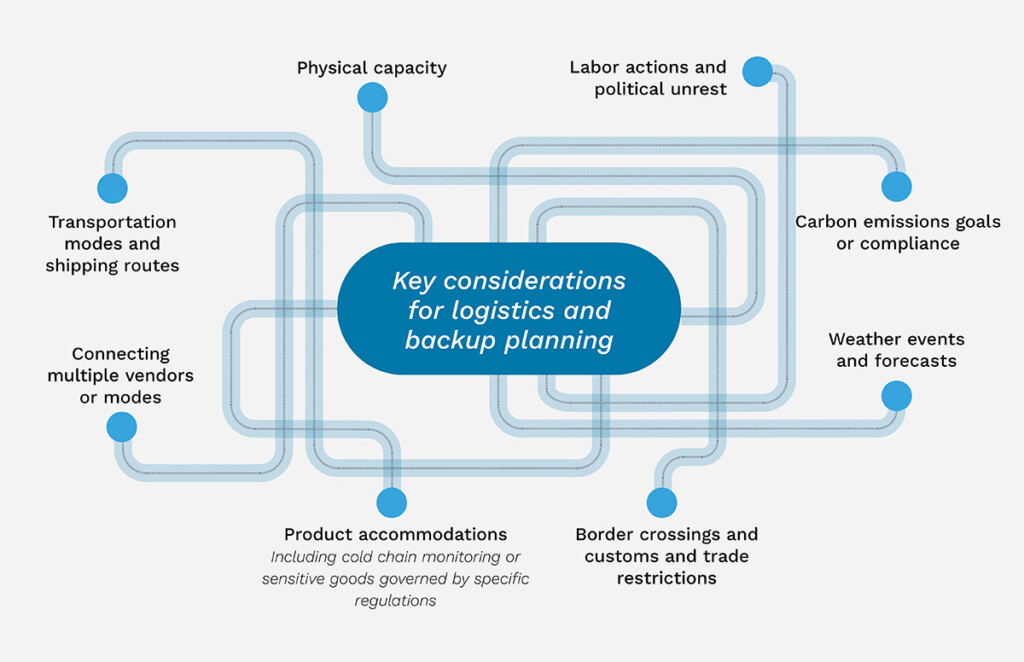
infographic showing key areas for risk management in logistics and backup planning

Figure 1: Use the visibility into potential logistics disruptions to form contingency plans

Can you predict weather disruption?

Weather-related disruptions represent some of the most common risks in logistics operations. Severe weather events have increased by 83% since 2000, but these events, and their disruptive impacts are highly predictable.  

Hurricanes don’t appear out of nowhere. Meteorologists can track them for days or weeks before landfall. Predictive weather analytics can give you 15-day weather forecasts allowing you to plan around extreme weather.  

Supply chain risk management solutions for logistics can contextualize this information for your logistics operation. This information can then predict how weather events will impact your locations, shipping lanes, and transportation routes. 

Can you predict port disruption?

The predictability extends far beyond weather. Port congestion often follows clear patterns based on seasonal shipping volumes, infrastructure capacity, or closures at neighboring regional ports. Weather events or regional instability can predict port closures. 

Can you predict labor strikes?

Labor disputes build up over months of contract negotiations. By monitoring labor relations and contract expiration dates, it is possible to predict when and where strikes are likely to occur. 

Can you predict insolvencies?

Supplier and carrier insolvencies rarely come without warning signs. Financial monitoring can reveal red flags indicating a logistics service provider is heading toward bankruptcy. By paying attention to these signals, you can make alternative arrangements before a carrier insolvency.  

Some risks, like earthquakes, cannot be predicted. But many others exhibit patterns. These patterns can be identified and tracked. As a result, supply chain disruptions can be anticipated, allowing you to make informed decisions to manage risk. 
Supply Chain Risk Insights

Explore how Everstream Analytics helps supply chain teams contextualize fast-moving threats.


Get the report

Can you predict the cascading consequences of logistics disruption?

As discussed, many logistics risks are predictable. However, even when an initial event is unpredictable, the cascading effects that follow almost always unfold in predictable patterns. 

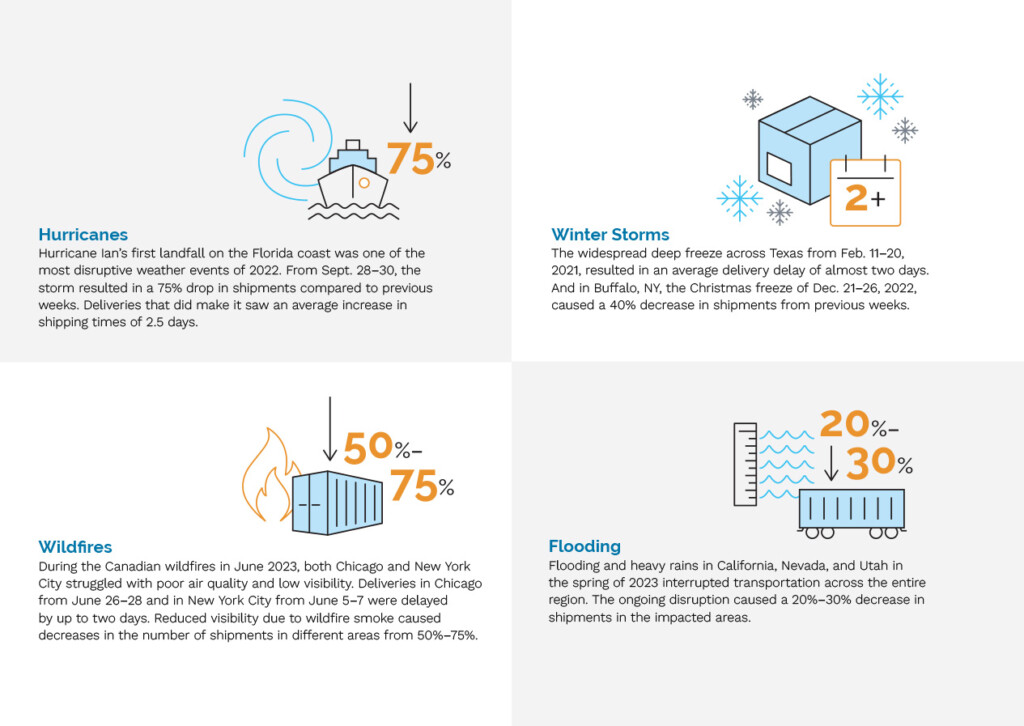
Real-world examples illustrate just how predictable these impacts can be. When Hurricane Ian hit Florida in 2022, shipments dropped by 75%. Deliveries that got through took an average of 2.5 days longer. 

The Texas winter storm in February 2021 resulted in an average delivery delay of almost two days. During the Canadian wildfires in June 2023, visibility dropped. This caused shipment volumes to decrease by 50% to 75% in affected areas. 

Extreme weather events have increased, but companies leveraging risk-optimized logistics can predict and prepare for them.

Figure 2: Weather events cause predictable impacts on shipments and delivery times 

These impacts follow predictable patterns because logistics networks operate according to physical and economic laws. When a hurricane closes a major port, carriers reroute cargo to alternative ports. Those ports have limited capacity, so congestion builds up predictably.  

As capacity becomes constrained, prices increase according to basic supply and demand principles. 

A single event can trigger a domino effect across multiple transportation modes and geographic regions.  

When the Ports of Los Angeles and Long Beach had delays during the COVID-19 pandemic, the clear choice was to reroute to Oakland. Because so many people had the same idea, Oakland quickly became congested too. Companies that understood this pattern turned to Gulf Coast ports. There, they found more reliable port times and ground shipping options. 

Even cybersecurity incidents follow recognizable patterns in their impacts. When a cyber-attack hits a major port operator, the predictable secondary effects include: 

  • Increased transit times 
  • Higher volumes at nearby ports 
  • Capacity constraints 
  • Greater demand for alternative transportation 
  • Price hikes for expedited freight 

What are the economic benefits of preventing logistics disruption?

The financial case for predictive logistics risk management is overwhelming. When you can predict risks and their impacts, you can act to avoid them. That action translates directly into dollars saved. 

Every year, supply chain disruptions cause a loss of $184 billion globally. The direct costs include: 

  • Expedited freight 
  • Lost or damaged goods 
  • Replacement inventory 
  • Penalty fees 
  • Unexpected demurrage charges 
  • Replacement shipping expenses 

But indirect costs often dwarf immediate expenses:  

  • Production downtime 
  • Lost sales 
  • Delayed revenue recognition 
  • Higher inventory levels  
  • Time costs managing preventable crises 

Response times make the math even starker. Research shows 41% of organizations take a full week just to identify impacted materials. Furthermore, companies need an average of two weeks to plan and execute responses.  

You cannot perform contingency planning without visibility into which shipments and materials have been impacted. However, these response times are too slow to maintain a competitive advantage in today’s business environment. 

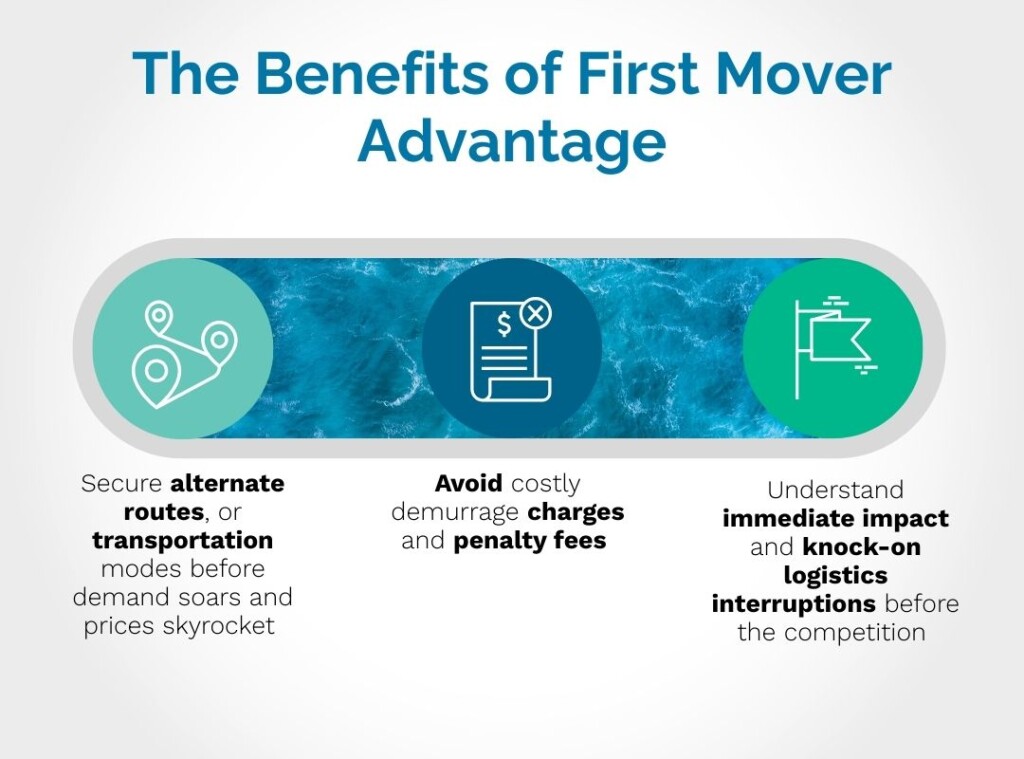
This is where first-mover advantage becomes crucial. When major global supply chain disruptions occur, thousands of organizations scramble for the same limited resources—alternative routes, backup carriers, expedited shipping. This surge drives up prices and constrains capacity. Companies that predict disruptions and act before they occur can secure resources at normal market rates. 

Graphic showing first mover advantage when disruption happens

Figure 3: Reacting first to disruptive events has significant financial benefits

Real-world examples of companies preventing logistics disruption

Consider a global automotive supplier during the Red Sea crisis. Early alerts warned of the developing situation, so the company quickly rerouted vessels around the Cape of Good Hope. Rather than accepting weeks of additional transit time, they shifted shipments to a China-Russia-Poland rail route.  

This decision cut transit time by seven days and avoided astronomical air freight costs. The company also had no production stoppages that would have cost an estimated $1 million per month. 

A leading food and beverage company provides another compelling example. Using risk insights with 14-day weather forecasts, they made proactive equipment adjustments. As a result, they avoided both transportation cost premiums and spoiled loads. The result: $2 million in direct annual savings and complete elimination of losses from spoilage. 

How to move from reactive to predictive logistics risk management

Supply chain resilience involves identifying and prioritizing risks to get ahead of them. This begins by identifying the underlying risk associated with your company locations, carrier hubs, shipping lanes, and logistics nodes.  

Once this is done, you will be able to see predicted risk to shipments during the planning phase. 

Advanced supply chain AI platforms can monitor thousands of risk variables across global logistics networks. This provides an early warning system that gives you the time and information to make smart decisions.  

Modern risk intelligence software solutions integrate directly with existing systems. Predictive insights into disruptive threats become part of your logistics planning workflow. 

Success requires a change in thinking. Instead of seeing disruptions as unavoidable, view them as problems to solve.  

Companies that make this change now will do well both now and in the long term. While the competition flails in the face of challenge, they will create better customer satisfaction by being more reliable. 

This shift represents more than tactical change. A fundamental transformation in how logistics operations create value occurs. Instead of being a cost center that occasionally creates problems, logistics becomes a strategic asset delivering consistent competitive advantage. 

Get Ahead of Logistics Disruption 

To understand how risk-optimized logistics can transform your operations, contact contact Everstream Analytics for a demo. 

Supply Chain Risk Insights

Explore how Everstream Analytics helps supply chain teams contextualize fast-moving threats.


Get the report

Share this post